What Is a Demographic Question and How to Use It Right
Learn practical form optimization strategies in this AgentsForForms guide: What Is a Demographic Question and How to Use It Right.
A demographic question is designed to help you understand who your audience is by gathering information on their background and characteristics. Think of it as the lens that brings your user data into sharp focus, revealing the human stories hidden within the numbers.
These questions are the key to turning a fuzzy, abstract picture of your audience into a crystal-clear portrait.
What Are Demographic Questions Actually For?
Imagine trying to understand a book by only reading every tenth word. You’d get a vague idea of the story, but you’d miss the characters, the plot, and the true meaning. Without demographic questions, you're doing the same thing with your data—you’re seeing an incomplete picture.
At its core, a demographic question is a tool for segmentation. It allows you to group responses based on shared traits, transforming a single, massive block of feedback into a rich tapestry of distinct insights. This isn't just an academic exercise; it's a strategic advantage that drives smarter decisions across your entire organization.
Uncovering Hidden Patterns in Your Data
The main goal here is to move beyond bland averages and uncover the important nuances within your audience. For instance, you might discover that while your overall customer satisfaction is high, users in a specific age group are consistently frustrated. Or maybe a new feature is a massive hit in one country but completely ignored in another.
These are the kinds of insights that are crucial for:
- Marketing Teams: To stop shouting into the void and start having personalized conversations. Demographic data helps create targeted campaigns that actually resonate with specific segments, leading to better ad spend and higher conversion rates.
- Product Teams: To build products for real people, not just abstract user personas. Understanding who uses which features helps prioritize the development roadmap and ensure new releases meet the needs of your most important customer groups.
- HR Departments: To build a solid foundation for diversity, equity, and inclusion (DEI) initiatives. Anonymous demographic data provides a baseline to measure progress and identify where the company can improve its workforce representation.
This infographic shows how a demographic data lens clarifies insights for marketing, product, and HR teams.
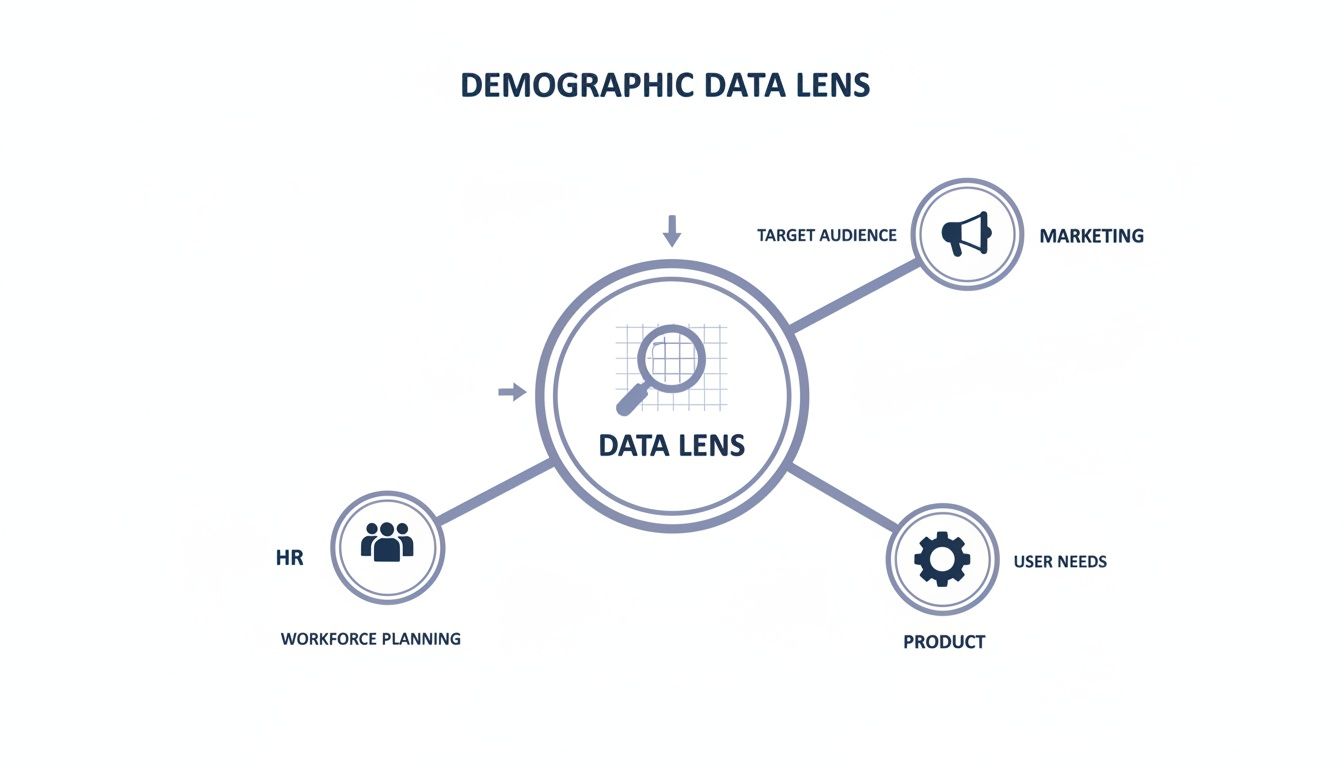
As the visual shows, a single source of data can power distinctly different—but equally valuable—strategies across the business.
Now, a lot of people worry that asking for personal information will scare users away from completing a form. But when you do it thoughtfully, that's rarely the case. In fact, a 2023 study found no significant difference in survey response rates whether demographic questions were included or not. This tells us that people are generally willing to share this data when the process feels respectful and secure. You can read the full research on survey response rates here.
This is where a well-designed process, like the kind you'd build for a customer intake form, makes all the difference.
Why and When to Ask Demographic Questions

Knowing what a demographic question is opens up its strategic power. This isn't just about filling a spreadsheet; it’s about making smarter, more empathetic decisions that actually move the needle. The real magic happens when you understand why you need the information and when is the right moment to ask for it.
When used thoughtfully, these insights become a game-changer for different teams. For marketers, it’s the difference between a generic campaign that misses the mark and a laser-focused one that speaks directly to a specific audience. The result? Maximum impact and less wasted ad spend.
Product managers lean on this data to make sure new features serve a diverse user base, not just the loudest voices in the room. By looking at feedback through a demographic lens, they can spot underserved groups and build more inclusive—and ultimately more successful—products.
Timing Is Everything: Ask When You've Earned It
The most critical part of collecting demographic data is context. Asking for personal information should never feel random or nosy. In fact, the timing of your request can be the deciding factor between a user sharing their info or abandoning your form completely.
The golden rule: Ask after you've provided value. A user who has just completed a helpful task, received useful information, or successfully signed up is far more likely to trust you with their data.
Think about these strategic moments to pop the question:
- During Onboarding: Right after a user creates an account, when they're excited to get started.
- In User Profile Settings: Give people the option to voluntarily add more details to their profile on their own time.
- After a Positive Interaction: Following a great customer support chat or after they've completed a key action in your app.
How Different Teams Put This Data to Work
Different departments can use this information in very specific ways. For example, an HR team can analyze anonymous demographic data to measure and improve its Diversity, Equity, and Inclusion (DEI) initiatives. It helps them see if they're actually building a representative and fair workplace.
Meanwhile, a customer support team might notice that users from a specific country are all reporting the same bug. That insight allows them to proactively fix a localized problem, like a bad translation or a regional server issue, before it gets worse.
Ultimately, the goal is to weave demographic questions into a natural part of the user journey. By explaining why you're asking and choosing the perfect moment, you turn a simple form field into a powerful tool for building better products, stronger marketing, and more inclusive organizations. This thoughtful approach not only gets you better data but also strengthens the user's relationship with your brand.
How to Write Demographic Questions That People Will Answer

It’s one thing to know what a demographic question is, but it's another thing entirely to write one that people actually feel comfortable answering. The real art lies in the phrasing—turning a clinical-feeling question into a respectful one. It all boils down to thoughtful wording and inclusive design that helps you gather accurate data while making every single person feel seen.
You can grab a generic template, sure, but you’ll get much better results by tailoring your questions to your specific goal. A question designed for product research is going to look and feel very different from one used in an HR survey. It's all about context.
Examples for Sensitive Topics
Let's be honest, asking about personal characteristics can be tricky. Topics like gender, ethnicity, and income are sensitive, and if you handle them poorly, people will simply close the tab. The secret is to provide options that reflect the real world and always give people an out.
Gender Identity:
It's time to move beyond the binary. Modern, thoughtful forms offer multiple options to ensure everyone can answer accurately and comfortably.
- Question: What is your gender?
Options:
- Woman
- Man
- Non-binary
- Prefer to self-describe: [Open text field]
- Prefer not to say
Ethnicity:
Broad, unhelpful categories are a thing of the past. Instead, offer specific choices that make sense for your audience and always allow for multi-racial identification.
- Question: How do you describe your race or ethnicity? (Select all that apply)
Options:
- Asian
- Black or African American
- Hispanic or Latino
- Native American or Alaska Native
- White
- Something else: [Open text field]
- Prefer not to say
Income:
Most people are hesitant to share an exact salary figure. Using ranges makes the question feel way less intrusive and significantly boosts your chances of getting a response.
- Question: What is your approximate annual household income?
Options:
- Less than $25,000
- 49,999
- 99,999
- 149,999
- $150,000 or more
- Prefer not to say
Key Takeaway: Including a "Prefer not to say" option isn’t just nice to have; it's non-negotiable. Research has shown this simple addition can be the difference between someone skipping a single question and abandoning your entire survey.
Crafting Questions for Different Goals
The "why" behind your survey should shape every question you ask. Think about who's going to use the data and what they need to achieve.
- For Marketing: If you're segmenting an email list, you might ask about a person's industry or company size. The goal here is to deliver more relevant, personalized content.
- For Product Teams: To figure out how a new feature is being used, you might ask about a user’s job role or their level of technical expertise. The goal is to get a complete picture.
- For HR: In an anonymous DEI survey, you'll need to ask detailed (but optional) questions about identity to get an accurate read on workplace diversity. The goal is pure inclusivity.
The format of your questions matters, too. For most demographic info, multiple-choice or checkbox fields are your best bet. If you want to dive deeper into structuring your forms, check out our guide on different question types in forms. When you combine clear language, inclusive options, and the right format, you’re not just asking questions—you’re building trust and gathering the high-quality data you actually need.
Best Practices for Designing Your Questions

Asking a good demographic question is more art than science. It's really about building trust. The way you frame your questions can be the difference between getting rich, accurate data and watching users abandon your form halfway through. Think of it like a conversation—if you’re respectful and clear, people are far more likely to open up.
Your goal should be to make these questions feel less like an interrogation and more like a simple, optional request. This approach not only protects the user's experience but also safeguards the quality of your data in the long run.
Focus on Clarity and Inclusivity
First things first: your language has to be simple and direct. Steer clear of any industry jargon or overly academic terms that might confuse people. A question is only useful if your respondent knows exactly what you're asking.
Inclusivity is just as crucial. The options you provide should reflect the real-world diversity of your audience. Forcing people into outdated binaries for gender or ethnicity makes them feel invisible or misrepresented. When that happens, they’ll either give you bad data or just leave.
- Be direct: Use clear, straightforward language. No fluff.
- Be inclusive: Offer a comprehensive range of options that people can actually see themselves in.
- Be flexible: Always, always include a "Prefer not to say" or "Prefer to self-describe" option.
Make Sensitive Questions Optional
This one is non-negotiable. Any question that touches on personal details—like income, ethnicity, gender identity, or disability status—must be optional. Making these fields required is the fastest way to break trust and send someone running for the exit button.
By making sensitive questions optional, you show respect for user privacy. This simple act can significantly increase the chances that a user will complete the rest of your form, even if they skip a few questions.
Explain Why You’re Asking and When to Ask
Transparency is your best friend here. A quick, honest explanation can make all the difference. Something as simple as, "This information helps us build more inclusive features," can completely change how someone feels about your request.
Where you place these questions is also a huge strategic decision. The overwhelming consensus from years of practice is to put demographic questions at the end of your form or survey. By then, the user has already invested their time and is more likely to answer these final, optional fields.
Trends in survey data back this up. As web surveys became more common, overall response rates climbed from 48% in 2005 to 68% in 2020. Placing demographics correctly helps maintain that engagement. In fact, studies confirm that putting demographic questions at the end boosts completion, with 32.7% of respondents answering at least one, compared to just 28.3% when they're on a separate page. You can discover more insights about survey engagement trends to see how small design choices matter.
The table below really highlights how tiny tweaks in your approach can have a massive impact on your results.
Do's and Don'ts of Crafting Demographic Questions
| Best Practice (Do) | Common Mistake (Don't) |
|---|---|
| Use inclusive ranges for age and income. | Ask for an exact age or salary figure. |
| Place demographic questions at the end. | Lead with personal questions upfront. |
| Clearly state that questions are optional. | Make sensitive fields required. |
| Provide a "Prefer to self-describe" option. | Limit options to outdated binaries. |
Putting these best practices into play transforms data collection from a potential roadblock into a genuine trust-building exercise. For more complex forms, a tool like AgentsForForms can automate this process, generating inclusive copy, smart validation, and consent language to ensure your questions are both effective and respectful.
Navigating Privacy, Consent, and Data Security
Asking for demographic data is a big deal. Get it wrong, and you don’t just end up with skewed results—you can permanently damage your relationship with your users. Navigating the world of privacy isn't just about dodging fines from regulations like GDPR or CCPA; it's about showing genuine respect for the people on the other side of the screen.
Think of it as a two-way street. You’re asking for personal details, and in return, you owe them radical transparency about how you'll use and protect that information. This means getting clear, informed consent before they even see the first question.
Building Trust Through Transparency
When you’re collecting demographics, you have to start with understanding Personally Identifiable Information (PII) to make sure you handle it correctly. Lots of demographic answers, like age or location, can easily fall into this sensitive category.
The first step is to be upfront about your intentions. In simple, clear terms, explain:
- Why you need it: Connect the data directly to a user benefit. For example, "This helps us build more inclusive features for everyone."
- How you'll use it: Be specific. Mention if the data will be anonymized and aggregated for high-level analysis.
- How you'll protect it: A quick, reassuring statement about your security practices goes a long way.
Your privacy notice shouldn't read like a legal textbook. Use plain, simple language that a real person can actually understand in seconds. Honesty builds more trust than a wall of jargon ever could.
Remember, comfort levels with these kinds of questions vary wildly around the world, which can directly affect who responds. A 2021 analysis of over 2,500 surveys found that patient response rates in India were over 93%, while in the US, they hovered around 64.2%. This huge gap shows just how critical building that initial trust is, especially if you have an international audience.
Ultimately, your approach to privacy and consent says everything about your brand's values. Handling it with care is the only way to collect meaningful data and build lasting relationships with your users. To learn more, check out our guide on how a digital consent form can build trust while keeping you compliant.
Common Questions About Demographic Surveys
Even with the best of intentions, handling demographic data can feel like walking a tightrope. This section is your go-to guide for navigating the tricky questions and real-world challenges that pop up for marketing, HR, and product teams.
Think of it as the practical advice you need after you’ve decided to start collecting this incredibly valuable information.
Are Demographic Questions Required for DEI Reporting?
This is a big one. While there isn't always a universal law forcing you to collect this data, it's pretty much essential for any meaningful Diversity, Equity, and Inclusion (DEI) program. For many businesses, it's also a must-have for specific compliance filings, like the EEO-1 report in the United States.
Here’s the golden rule: always make these questions voluntary for employees. You also need to be crystal clear about why you're asking and how the information will actually help advance your DEI goals. When in doubt, it’s always smart to talk to a legal expert to get advice specific to your region and industry.
How Can I Ask About Gender and Ethnicity Inclusively?
This isn't just about being polite; it's about building trust and getting data you can actually rely on. If your options are vague or outdated, people will feel invisible, and many will just close the tab.
- For Gender: The old "Male" and "Female" binary just doesn't cut it anymore. Best practice is to include options like "Non-binary," a "Prefer to self-describe" choice with a text box, and, of course, "Prefer not to say."
- For Ethnicity: Try to avoid huge, generic buckets that mash different cultures together. Instead, offer specific choices that make sense for your audience. Always include options like "Multiracial," a write-in field, and "Prefer not to say." The U.S. Census Bureau's approach is a great reference to get you started.
What Is the Best Way to Increase Response Rates?
Getting more people to answer these sensitive questions boils down to two things: building trust and making it easy. Start by explaining exactly why you need the data and how you’ll use it to make their experience better.
Guaranteeing anonymity and reassuring users about data security right upfront can significantly increase their willingness to share.
It also helps to place these questions at the very end of a survey, after you’ve already built a bit of rapport. Keep the section short, and make every single question optional. A clean, multi-step layout with a progress bar can also work wonders by making the whole process feel less overwhelming.
Can I Use AI to Analyze This Kind of Data?
Absolutely. In fact, AI is a game-changer here. It can dig through demographic data and spot complex patterns and connections that a human analyst might completely miss.
For example, an AI tool could instantly cross-reference product satisfaction scores with a user’s age, location, and income to pinpoint the exact profile of your most enthusiastic customers. Modern platforms can pull out these deep insights in minutes, even if you don't have a data scientist on staff. This means you can turn raw numbers into smart, actionable strategies much faster.
Ready to create smarter, more respectful forms without the headache? AgentsForForms uses AI to instantly generate clear, inclusive demographic questions with smart validation and consent language built right in. Start building better forms for free.