How to Measure Employee Satisfaction and Boost Morale
Learn practical form optimization strategies in this AgentsForForms guide: How to Measure Employee Satisfaction and Boost Morale.
Figuring out if your employees are truly happy isn't just about gut feelings or casual conversations in the breakroom. It requires a thoughtful mix of methods, from structured surveys and one-on-one meetings to tracking hard numbers like turnover and absenteeism rates.
The real goal here is to gather both quantitative data (the 'what') and qualitative feedback (the 'why'). Blending these two gives you a complete picture of how content your team really is, turning subjective feelings into business intelligence you can actually act on.
Why Measuring Employee Satisfaction Is a Business Imperative
Understanding how your team feels has moved far beyond a once-a-year HR checklist. It’s now a critical driver of business success. A satisfied team doesn't just make for a nicer office environment; it directly fuels productivity, boosts retention, and strengthens your bottom line.
Viewing employee satisfaction as a "nice-to-have" is a dangerously outdated mindset. Think of it more like an essential diagnostic tool for your company's health. By creating a continuous listening strategy, you uncover the real story behind what your employees think and feel, giving you the data you need to build a resilient, motivated workforce.
The Shift from Pay to Purpose
What keeps people happy at work is changing. A landmark 2025 Job Satisfaction Survey from The Conference Board hit a historic high, but the reasons why might surprise you. The top drivers weren't salaries or bonuses, but intrinsic factors like genuine interest in the work, the quality of leadership, and the overall company culture. You can dive deeper into the full job satisfaction report to see the full breakdown.
This tells us that superficial perks just don't cut it anymore. To get a real pulse on satisfaction, you have to measure the things that truly matter:
- Psychological Safety: Do people feel safe enough to voice opinions or make mistakes without fear of blame?
- Career Growth: Are there clear, accessible paths for professional development?
- Managerial Support: Do managers actively support their team's well-being and success?
- Connection to Mission: Does everyone feel like their work contributes to a meaningful purpose?
The most dangerous assumption in business is that your employees are happy simply because they haven’t quit. Proactive measurement is the only way to know the truth before your best talent walks out the door.
Ultimately, the insights you gather aren't just for a report that sits on a shelf. They should directly inform your strategies for improving employee satisfaction across the organization.
Before we dive into the "how-to," let's quickly summarize the most common methods you'll be using.
Key Methods for Measuring Employee Satisfaction
This table gives you a quick snapshot of the primary tools and metrics used to gauge how your employees are feeling. We'll explore each of these in much more detail throughout this guide.
| Method | What It Measures | Best For |
|---|---|---|
| Pulse Surveys | Real-time sentiment on specific, timely topics | Quick feedback on recent changes or initiatives |
| eNPS | Employee loyalty and willingness to recommend the company | A simple, consistent benchmark for overall sentiment |
| Annual Engagement Surveys | Deep, comprehensive insights into long-term drivers | In-depth strategic planning and culture assessment |
| One-on-One Meetings | Individual concerns, career goals, and manager relationships | Personal, nuanced feedback and building trust |
| Exit Interviews | Reasons for departure and honest feedback on company culture | Uncovering systemic issues that drive turnover |
| Absenteeism & Turnover Rates | Overall organizational health and signs of disengagement | Identifying 'at-risk' teams or departments with hard data |
Each of these methods provides a different piece of the puzzle. The real power comes from combining them to get a complete, multi-faceted view of your workplace.
Building Your Measurement Framework
Firing off a survey without a clear plan is a recipe for disaster. You'll get a mountain of data, sure, but you won't know what any of it means or what to do with it. Before you even think about writing questions, you need to build a solid framework that ties your efforts back to what the business actually cares about.
The first step is to get specific about your goals. What are you really trying to solve? Maybe you're bleeding talent in the engineering department and need to figure out why. Or perhaps you're trying to boost innovation on the product team after a big company restructuring. Each of these goals demands a completely different approach to measurement.
Selecting Your Core Metrics
With a clear goal in hand, you can pick the right KPIs to track. A simple "satisfaction score" is a decent starting point, but it barely scratches the surface. To get the full picture, you need a blend of metrics that capture different angles of the employee experience.
Here are a few I always recommend starting with:
- Employee Net Promoter Score (eNPS): This is the classic. It boils loyalty down to one question: "On a scale of 0-10, how likely are you to recommend our company as a place to work?" It’s a fantastic, high-level benchmark for tracking sentiment over time.
- Engagement Indicators: These questions dig deeper into an employee's emotional connection to their work. You can measure things like their motivation, their pride in the company, or their willingness to go the extra mile.
- Sentiment Analysis: This is where you get the "why" behind the numbers. Analyzing the tone and emotion in open-ended comments—whether they’re positive, negative, or neutral—can uncover insights you’d never get from a multiple-choice question.
I once worked with a tech company that was struggling with morale after a big leadership shake-up. An eNPS survey gave them a baseline, but the real gold was in the engagement questions we added about trust in leadership and clarity of vision. That’s what pointed them to the core of the problem.
This turns measurement from a simple check-the-box exercise into a powerful diagnostic tool. The whole process is really a continuous cycle of listening, analyzing, and acting on what you learn.
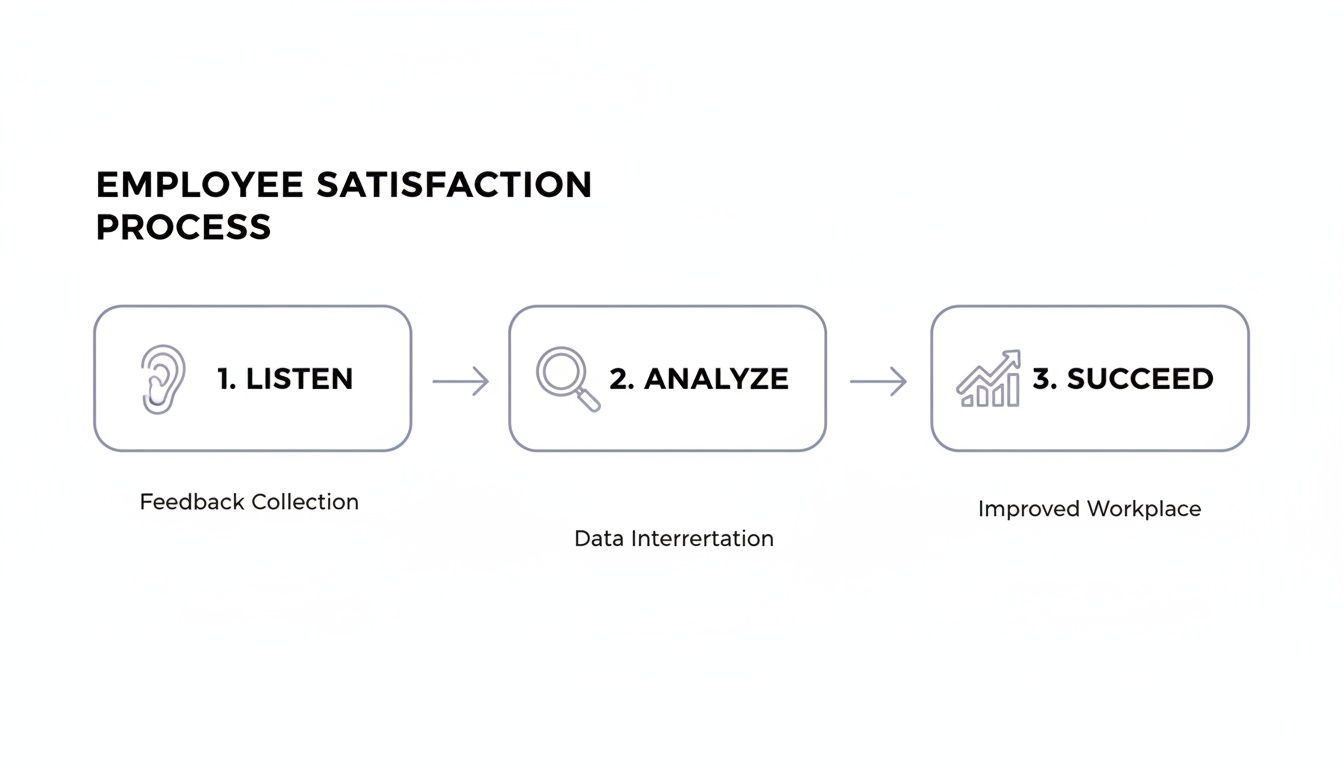
This simple loop is the key. Success isn't about a single survey; it's about creating a constant feedback rhythm that leads to real change.
Aligning Metrics with Business Challenges
This is where your framework really starts to pay off—by helping you diagnose specific business problems. Let's say your main goal is to reduce turnover. If you track satisfaction scores alongside attrition rates by department, you might find some glaring issues.
For example, you could discover that while overall company satisfaction is a solid 75%, the sales team is sitting at a worrying 45%. Boom.
That single data point tells you exactly where to focus your energy. Your framework has just evolved from a vague morale check into a surgical tool for targeted intervention. As you start crafting your questions, it’s also helpful to know the right tool for the job. Our guide on the difference between a survey and a questionnaire can help you fine-tune your approach.
Crafting Surveys People Actually Want to Fill Out
Let's be honest: the quality of the feedback you get is a direct reflection of the quality of your survey. A clunky, poorly designed survey doesn't just give you messy data—it can actively kill trust and create a bad case of "survey fatigue," where your team just stops responding.
The real goal here is to build something that feels less like a mandatory chore and more like a genuine chance for your employees to be heard.

It all starts with a smart mix of question types. It’s tempting to stick to simple yes/no questions because they're easy to analyze, but that's where you miss all the important details. A more balanced approach is the only way to truly understand how people are feeling.
Finding the Right Mix of Questions
A truly effective survey is a blend of quantitative and qualitative questions. You need to capture both the "what" and the "why" to get the full story. Each type of question has a specific job to do.
- Likert Scales: These are your bread and butter for measuring sentiment. Think of questions like, "On a scale of 1 (strongly disagree) to 5 (strongly agree), do you feel you have opportunities for career growth?" They're perfect for spotting trends and tracking progress over time.
- Open-Ended Questions: This is where the gold is. A simple follow-up like, "What is one thing we could do to improve your career growth opportunities?" can give you more actionable ideas than a dozen multiple-choice questions ever could.
Of course, the real trick is asking the right questions. If your questions are vague or leading, you'll get vague, biased answers. To see what great questions look like in practice, check out our guide on employee engagement survey questions for teams.
Pro Tip: I can't stress this enough—always pilot your survey. Before you send it out to everyone, get a small, trusted group of 5-10 employees to take it. This simple gut-check can catch confusing wording or technical glitches before they become a company-wide headache.
Building Trust with Anonymity and Smart Timing
If you want candid feedback, your employees have to feel safe. Guaranteed anonymity is non-negotiable, especially when you're digging into sensitive topics like manager performance or pay. You have to be crystal clear about how you're protecting their identities, whether that's through a third-party tool or by only ever looking at the data in aggregate.
When you send the survey also matters. Don't fall into the trap of only running one huge annual survey. A much better approach is to create a rhythm that balances deep dives with quick check-ins:
- Comprehensive Annual Survey: This is your big one. Use it to go deep on foundational topics like company culture, benefits, and long-term career aspirations.
- Quarterly Pulse Checks: Think short and sweet. These are focused surveys (5-7 questions) that track feelings about recent changes or current business priorities.
This blended frequency shows you’re always listening, not just checking a box once a year. It also helps you get a real-time pulse on your team. Global data reveals a pretty startling disconnect: only 23% of employees report feeling engaged, while a staggering 62% are actively disengaged. That gap is precisely why you need to measure more than a single satisfaction score to get an accurate picture. You can dig into more of these numbers in the full global workforce data report.
Turning Raw Data Into Actionable Insights
Collecting employee feedback is just the start. Raw data, on its own, doesn’t give you answers. The real magic happens when you interpret that data—transforming a jumble of numbers and comments into a clear story that shows you exactly what to do next. A company-wide satisfaction score is a fine starting point, but it almost always masks the problems that truly matter.
The most powerful way to dig deeper is through data segmentation. Instead of just looking at one big number, you slice your data by different employee groups. This is how you stop asking what your employees are feeling and start understanding who is feeling it and, most importantly, why.

Uncovering Hidden Trends in Quantitative Data
Start by breaking down your results to compare experiences across the organization. This segmentation can uncover some surprising gaps that a high-level average would completely wash over.
Try looking at your data through a few different lenses:
- Department: Is the engineering team flying high while the sales team is struggling? A low score in one area often points to localized issues, whether it’s management, tools, or workload.
- Tenure: Are new hires (those in the 0-6 month range) noticeably less satisfied than your long-term veterans? That could be a red flag for a broken onboarding process that needs fixing—fast.
- Location or Work Model: Do your remote employees report higher satisfaction than your in-office teams? Insights like this are gold when it comes to shaping future workplace policies.
- Role Hierarchy: Are managers consistently more optimistic than individual contributors? Uncovering these perception gaps is absolutely vital for building a culture that feels fair and equitable to everyone.
This kind of analysis is critical because satisfaction is never one-size-fits-all. A 2025 PwC survey found that 78% of private equity workers felt satisfied multiple times a week, a stark contrast to the 64% average across all industries. Even more telling, executives (72%) were far more upbeat about their jobs than non-managers (43%), which proves just how essential segmentation is for getting a true picture. You can see more of these workplace dynamics in the full hopes and fears survey.
Making Sense of Qualitative Feedback
While the numbers tell you what is happening, the written comments tell you why. Diving into a sea of qualitative feedback can feel like a huge task, but a straightforward approach called thematic analysis makes it manageable. The goal is simple: find the recurring patterns and ideas in all those open-ended responses.
You can start this manually. Just read through the comments and start grouping similar feedback into categories, or "themes." For example, you might notice a bunch of people mentioning the "outdated CRM," "slow approval processes," or "lack of recognition from leadership."
Don’t just ignore the one-off comments, but give most of your attention to the themes that pop up again and again. If five people mention a problem, it’s a trend. If twenty-five people mention it, it’s a critical issue that needs to be on your radar immediately.
For larger organizations with tons of feedback, AI-powered tools can speed this up dramatically. These platforms can automatically sort comments by sentiment (positive, negative, neutral) and pull out key topics without you having to read every single line. If you're curious about the mechanics, learning how AI turns raw data into actionable insights provides a great overview of the principles involved.
This is where it all comes together. When you combine your quantitative segments with your qualitative themes, you create a powerful narrative. You might discover that the sales team's low satisfaction score is directly tied to a dozen comments complaining about their CRM system. That’s not just data anymore—that’s a clear, specific problem you can actually go and solve.
Closing the Feedback Loop to Build Trust
Nothing kills employee trust faster than asking for feedback and then letting it disappear into a black hole. Honestly, this is where most companies drop the ball. The final, and I'd argue most crucial, step in this whole process is acting on what you’ve learned.
When you do this right, you transform a simple survey from a data-gathering exercise into a genuine conversation. You’re showing your team their voice actually matters. If you skip this, you’re practically guaranteeing cynicism and lower response rates next time. People need to see that their honest input leads to real, tangible change.
This is how you close the feedback loop.
Be Transparent When Sharing Results
Your first move after analyzing the data is to share it. I know it can be tempting to sweep the messy parts under the rug and only highlight the good stuff, but that’s a mistake. Real transparency means presenting a balanced view. Absolutely celebrate what’s working, but you have to be just as upfront about the areas that need serious work.
When you're ready to share the data, think about it this way:
- Give a Company-Wide Summary: An all-hands meeting or a company-wide email is perfect for outlining the big-picture themes that came up. Keep it high-level.
- Arm Your Managers: Give managers access to their own team’s results. This empowers them to have much more specific and meaningful conversations with their direct reports.
- Focus, Focus, Focus: Be crystal clear about the 1-3 issues leadership is committing to tackle in the coming months. It’s far better to make real progress on a few important things than to promise to fix everything at once and deliver on nothing.
Sharing survey results isn't just a report-out; it's a commitment. When you openly discuss the challenges, you're telling your employees, "We heard you, we see the problem, and we're in this together."
Turn Insights Into Action
Once you’ve communicated the "what," it's time to figure out the "how." In my experience, the best way to drive change is to empower the people closest to the problems. Forget top-down directives. Instead, form small, cross-functional "action teams" to own the specific challenges you identified.
I worked with a company a while back that discovered their new-hire feedback was consistently awful. The survey data pointed directly to a confusing and disorganized onboarding process. So, they created a task force made up of recent hires, a few seasoned employees, and someone from HR. Their one job was to completely revamp the first 90 days.
They got to work and created a clear onboarding checklist, assigned a dedicated mentor for every new employee, and scheduled structured check-ins. The result? Within six months, they saw a 20% jump in 90-day satisfaction scores.
That little story shows the incredible power of follow-through. It turns measurement from a one-time event into a powerful, ongoing cycle of listening, acting, and improving. To ensure the feedback you're acting on is candid in the first place, it helps to build trust from the very beginning. You can learn more by reading our guide on creating an anonymous feedback form that gets real answers.
Common Questions We Hear
When you're first figuring out how to measure employee satisfaction, a few questions always seem to pop up. Let's tackle them head-on, because getting these right from the beginning can save you a lot of headaches down the road.
How Often Should We Be Surveying Our Team?
This is a classic "Goldilocks" problem. Survey too often, and people get tired of it. Wait too long, and you're flying blind, missing crucial shifts in morale.
The sweet spot for most companies is a hybrid approach. Think of it like this:
- The Big Annual (or Semi-Annual) Survey: This is your deep dive. It’s where you ask the comprehensive questions about culture, career paths, compensation, and benefits—the slow-burning, foundational stuff.
- Quick Pulse Surveys: These are your regular check-ins, maybe monthly or quarterly. A quick pulse survey with just a few questions can give you a real-time feel for things, like how a new project is landing or the sentiment within a specific team.
This combination gives you both the big picture and the immediate, on-the-ground reality, allowing you to be proactive instead of just reactive.
What’s a Good Survey Response Rate, Really?
While there's no single magic number, a good rule of thumb is to aim for a response rate between 60% and 80%. If you're dipping below 50%, you have to start questioning if the results truly represent what your whole team is feeling. Making big decisions on skewed data is a risky game.
Getting people to participate isn't luck; it's about building trust. Here’s what actually works:
- Make Anonymity a Promise: And mean it. This is the single most important factor for getting honest answers.
- Explain the "Why": Tell your team exactly how their feedback will be used. "We're doing this to improve our professional development program" is much better than "Please take the employee survey."
- Keep It Short: Respect their time. A focused, 5-minute survey will always get better engagement than a 30-minute monster.
- Close the Loop: This is the most crucial step. When you share the results and the actions you’re taking based on the last survey, you prove that their voice matters. People will be far more willing to contribute again when they see it leads to real change.
Should Our Surveys Be Anonymous?
Yes. Absolutely, unequivocally, yes.
If you want the unvarnished truth about sensitive topics—like how people feel about their direct manager, their pay, or workplace stress—anonymity is non-negotiable. Employees need to feel 100% safe to speak their minds without any fear of it coming back to them.
Trust is the currency of feedback. Without the absolute assurance of anonymity, you're likely to get data that is polite and filtered, not honest and actionable. This completely defeats the purpose of the exercise.
You can always offer an optional way for people to identify themselves for follow-up conversations, but the default for the core survey must be confidential.
We’re Worried About Overpromising. How Do We Act on Feedback Realistically?
This is a smart concern. The key isn't to fix everything at once, but to be transparent and focused.
First, acknowledge what you heard—the good, the bad, and the ugly. Simply summarizing the key themes shows everyone you were listening.
Then, pick your battles. Instead of a vague promise to "improve everything," commit to tackling one to three key areas over the next quarter. Maybe it's improving the clarity of project goals or investing in better team-building activities. Be specific about what you’re doing and why. It’s far more powerful to make visible, meaningful progress on a few things than to promise the world and deliver nothing.
Ready to build smarter surveys that get you the answers you need? With AgentsForForms, you can turn a simple prompt into a production-ready employee satisfaction survey in seconds, complete with branching logic and anonymized response options. Start building for free and turn feedback into action.