Creating an Anonymous Feedback Form That Gets Real Answers
Learn practical form optimization strategies in this AgentsForForms guide: Creating an Anonymous Feedback Form That Gets Real Answers.
An anonymous feedback form is a simple but powerful tool that lets people share their thoughts, opinions, and criticisms without having to reveal who they are. It’s one of the best ways for any organization to gather unfiltered, honest insights from employees, customers, or users who might otherwise hold back for fear of saying the wrong thing.
The Hidden Value of Truly Anonymous Feedback
Let's be real—most feedback is filtered. People naturally soften their criticism or avoid sensitive topics when their name is attached. This is where an anonymous feedback form becomes a strategic game-changer. It creates a direct line to the kind of truth that sparks real growth and improvement. We're not just collecting suggestions here; we're uncovering the critical insights that are nearly impossible to get otherwise.

The whole process hinges on creating a sense of psychological safety, where people feel secure enough to be vulnerable. When respondents trust that their identity is protected, they are far more willing to share nuanced, constructive, and sometimes difficult feedback that you actually need to hear.
Uncovering Blind Spots in Your Business
Every organization has blind spots. These are the problems or frustrations that are common knowledge among the team but somehow remain invisible to leadership. An anonymous feedback form is one of the most effective ways to drag these hidden issues out into the open.
Think about these real-world scenarios:
- A product manager finally discovers the specific friction point causing users to abandon a key feature. Their analytics show the drop-off, but only anonymous feedback reveals the why—a confusing UI element that users felt silly reporting.
- An HR leader pinpoints the root cause of a specific team's burnout. Instead of getting generic comments about "workload," they receive detailed, candid feedback about inefficient processes and a lack of key resources.
- A marketing team learns why a recent campaign with great traffic failed to convert. Anonymous comments reveal the messaging came across as out of touch with the audience's core values.
In every case, anonymity was the key that unlocked truly actionable information. The feedback wasn't just a complaint; it was a diagnosis.
"The goal of anonymous feedback isn't to create a space for complaints, but to build a channel for truth. When you remove the fear of judgment, you get the kind of raw data that leads to breakthrough improvements."
Fostering a Culture of Continuous Improvement
Putting an anonymous feedback system in place sends a powerful signal: you value honesty and are serious about getting better. It shows everyone that leadership is ready to hear the good, the bad, and the ugly, all in the name of making things better. This builds incredible trust and proves to employees and customers that their voices actually matter.
When you consistently act on the feedback you receive, you create a positive loop. People see that their input leads to real changes, which encourages them to provide even more thoughtful feedback in the future. Suddenly, your anonymous form isn't just a survey tool—it's a cornerstone of a healthy, transparent, and adaptive culture.
Building Trust Before You Build the Form
An effective anonymous feedback form is more than just a list of questions. It's the end result of a thoughtful strategy, and that strategy has to start with trust. Before you jump into a form builder or start brainstorming questions, you have to lay the groundwork. If you don't, even the most beautifully designed form will be met with crickets.

The success of your entire project hangs on one thing: whether your audience believes their feedback is truly anonymous and that you'll actually listen. This trust isn’t a given—you have to earn it.
Define Your Single Most Important Goal
First things first: what are you really trying to learn? A form without a sharp focus will only give you fuzzy, unusable data. Are you trying to get to the bottom of a recent dip in team morale? Or are you looking for unfiltered opinions on a new feature you just shipped? Your objective will dictate every other decision you make.
Try framing your goal as one specific question you need an answer to.
- Vague: "Get feedback on the new user dashboard."
- Specific: "What is the single biggest point of confusion for users during their first week with the new dashboard?"
See the difference? Clarity like this ensures you're gathering intelligence, not just opinions. It also helps you fight the urge to pack your form with a dozen unrelated questions, which is a surefire way to kill your completion rate.
Communicate Purpose and Guarantee Anonymity
With a clear goal in mind, it's time to talk to your audience. People are much more likely to participate—and be honest—when they know why you're asking and feel confident that their identity is safe. Your communication should hit three critical points:
- The Purpose: Tell them exactly what you hope to achieve with their feedback.
- The Process: Briefly explain how you'll collect and use the data. Who sees it? What happens next?
- The Promise: Make an explicit, unambiguous guarantee of anonymity.
When you promise anonymity, get specific. Saying you are not tracking IP addresses or that logins are not required is far more powerful than a generic "your feedback is anonymous." Details build credibility.
A Real-World Communication Example
Let's say a SaaS company wants to improve its onboarding. A lazy, generic announcement will get ignored. Instead, they need to build trust right from the first interaction with a targeted in-app message or email.
Here’s what a good one looks like:
Subject: Help Us Improve Your First Week Experience (100% Anonymously)
"Hi [User Name],
We're obsessed with making the first week on our platform as smooth as possible, and we need your honest thoughts to get it right.
We put together a short, completely anonymous feedback form to hear directly from you about what we can do better. Your insights will directly shape our product roadmap for the next quarter.
Your Privacy is Our Priority:
- This form does not collect IP addresses or any other personal identifiers.
- Your submission is not linked to your user account in any way.
- All feedback is aggregated and reviewed by our product team only.
Please take two minutes to share your candid thoughts. It’s essential for us to build a better tool for you.
Thanks,
The Product Team"
This message just works. It's transparent, specific, and respectful. It positions the feedback as a partnership, not just another survey to fill out. This kind of groundwork is what turns a simple form into a powerful tool for building trust and getting the unfiltered insights you actually need.
Asking Questions That Inspire Honest Answers
The most sophisticated anonymous feedback form on the planet will fall flat if the questions are vague, leading, or just plain confusing. The truth is, the quality of your feedback is a direct reflection of the quality of your questions. It's an art, really—balancing precision with an open mind to guide people toward the specific, actionable insights you need without putting words in their mouths.
The secret sauce is matching the question type to your ultimate goal. Are you trying to gauge sentiment, figure out the "why" behind a certain behavior, or group your audience into different segments? Each of these goals requires a completely different approach to get clean, useful data.
The Power of Open-Ended Questions
When you really need to get to the heart of an issue, nothing beats an open-ended question. These are the kinds of questions that can't be answered with a simple "yes" or "no." They invite people to share their stories, frustrations, and brilliant ideas in their own words, giving you that rich, qualitative data you just can't get from a rating scale.
Think of open-ended questions as your tool for exploring motivations and context.
- Instead of: "Do you like the new feature?"
- Try asking: "What was your initial reaction the first time you used the new feature?"
See the difference? The second version asks for a story. It digs for the experience behind the opinion, which is infinitely more valuable. Just be careful not to overdo it. Too many open-ended questions can cause survey fatigue and create a mountain of text for you to analyze. I've found a good rule of thumb is to place one or two at the end of a section to catch any thoughts that a multiple-choice format might have missed.
Anonymity is a superpower for open-ended questions. When people feel safe, they'll tell you about the confusing workflow, the annoying pop-up, or the inefficient process they would never bring up in a public forum.
Using Scales and Multiple Choice for Clarity
While open-ended questions give you depth, quantitative questions—like rating scales and multiple-choice options—provide structure and make your life a whole lot easier during analysis. They’re perfect for benchmarking sentiment and sorting feedback into useful categories.
Rating Scales (think 1-5 or 1-10) are fantastic for measuring things like satisfaction, agreement, or likelihood. They turn abstract feelings into concrete data points you can actually track over time.
Multiple-Choice Questions help you categorize your respondents or pinpoint specific problem areas. The trick here is to make sure your options cover all the bases and don't overlap. And please, always include an "Other (please specify)" option to catch those inevitable edge cases.
The format of your questions directly impacts the quality of anonymous feedback you'll receive. This table breaks down which question types to use for specific insights.
Choosing the Right Question Type for Honest Feedback
| Question Type | Best For | Example Question | Potential Pitfall |
|---|---|---|---|
| Rating Scale | Measuring sentiment, satisfaction, or agreement quantitatively. | "On a scale of 1 to 10, how likely are you to recommend our service?" | Can lack context; doesn't explain the "why" behind the score. |
| Multiple Choice | Segmenting users, identifying common issues, or easy data analysis. | "Which of these features do you use most often?" | Choices must be comprehensive and mutually exclusive. An "Other" option is crucial. |
| Open-Ended | Uncovering deep insights, root causes, and unexpected feedback. | "What is one thing we could do to make our product better for you?" | Can be time-consuming to analyze and may lead to survey fatigue if overused. |
| Yes/No | Getting quick, binary answers for simple questions. | "Did you find what you were looking for on this page?" | Lacks nuance and can oversimplify complex topics. Best used sparingly. |
For a much deeper dive into the nuances of each, check out our guide to different question types in forms.
Putting it all together, here’s how these types might work in a product feedback scenario:
- Rating Scale: "On a scale of 1-10, how satisfied are you with the new dashboard?"
- Multiple Choice: "Which part of the new dashboard have you used the most?" (Options: Analytics, Reporting, Settings, etc.)
- Open-Ended: "What is one thing we could do to make the dashboard more useful for you?"
This simple trio gives you a clear satisfaction score, tells you which feedback applies to which features, and captures specific, actionable ideas for improvement.
How to Write Neutral Unbiased Questions
The single biggest mistake you can make is writing a leading question. A leading question subtly nudges the respondent toward a particular answer, poisoning your data before you even collect it. Anonymity is powerful, but it can't fix a biased question.
Your goal should always be neutrality. Frame your questions as a genuine inquiry, not a hunt for validation.
Let's look at a real-world HR survey example:
- Leading Question (Before): "How much do you agree that our new 'unlimited PTO' policy has improved work-life balance?" (This phrasing assumes it has improved things and just asks the respondent to agree.)
- Neutral Question (After): "How has the new 'unlimited PTO' policy affected your work-life balance?" (This would use a neutral scale from "Significantly Worsened" to "Significantly Improved.")
The second version completely removes the bias. It allows for a full spectrum of responses—positive, neutral, or negative. It seeks to understand the true impact, not to confirm a positive one. That simple change is the difference between collecting propaganda and collecting the truth.
Choosing Your Tools and Ensuring True Anonymity
Promising anonymity is easy. Actually delivering on that promise? That's a whole different ballgame, and it all comes down to the tools you choose. This is where your initiative either earns trust or falls flat. A good platform doesn't just collect answers—it protects the person giving them and gives your team the secure, integrated tools needed to act on the insights.
You've got a wide spectrum of options. At one end, there are general-purpose tools like a standard Google Form. They're fast and familiar, but they weren't built with true anonymity in mind. They often collect email addresses or log IP addresses by default, which immediately puts your promise of privacy at risk unless you're diligent about reconfiguring them.
At the other end, you'll find specialized platforms built from the ground up for privacy. For these tools, anonymity isn't just a feature you can toggle on or off; it's the entire foundation.
The Non-Negotiables of Technical Anonymity
When we talk about "true anonymity," we're not just talking about a vague feeling of privacy. It's a set of concrete technical safeguards. Before you commit to any tool, you absolutely have to make sure it meets these baseline requirements. If it can't, it's simply not the right choice for gathering candid feedback.
Here's what to look for:
- No IP Address Collection: The platform must not log the respondent's IP address. This is one of the most common ways people can be inadvertently identified.
- No Required Logins or PII: The form should never force a user to sign in or provide personally identifiable information (PII) like their name, email, or employee ID just to submit a response.
- Encrypted Data Transmission: Any data sent through the form needs to be encrypted while it's in transit (using HTTPS/SSL) to block anyone from snooping on it.
- Secure Data Storage: Once collected, the feedback must be stored in a secure, encrypted database with rock-solid access controls.
A huge mistake I see people make is assuming a form is anonymous just because they didn't add a "Name" field. Real anonymity is about what the tool doesn't collect behind the scenes. Always, always verify the technical defaults before you go live.
If you want to dig deeper into how a platform handles data, comb through its privacy commitments. You can see how we approach it by exploring our detailed privacy policy at AgentsForForms.
Enterprise-Grade Features to Consider
For product managers and engineers, especially in larger companies, the checklist doesn't stop at basic anonymity. In an enterprise setting, you need tools that slot securely and seamlessly into your existing tech stack.
Here are a few other key features that can make a huge difference:
- GDPR and Compliance: The platform must be fully compliant with data privacy regulations like GDPR, which is non-negotiable if you’re collecting feedback from anyone in the EU.
- Single Sign-On (SSO): This might sound counterintuitive for an anonymous form, but SSO can be crucial for managing who has access to the form builder and the results dashboard without creating yet another set of login credentials for your team.
- Integrations (Slack, Zapier, Webhooks): The real magic happens when you can pipe feedback directly into your other systems. An integration that pushes an anonymized summary to a Slack channel or triggers a Zapier workflow can turn raw feedback into an actionable ticket in seconds.
This flowchart can help you think through how to structure your questions based on what kind of data you're actually after.
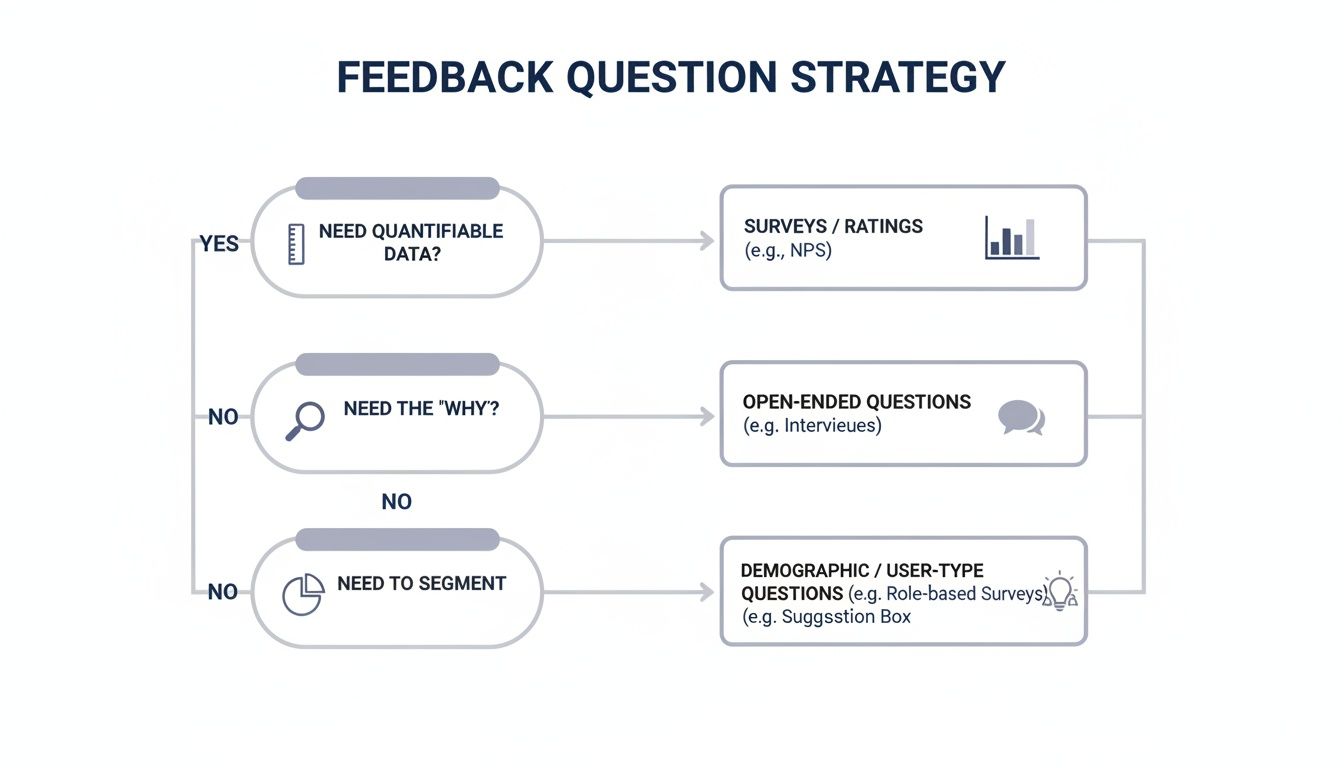
As you can see, the decision tree really clarifies how your primary goal—whether it's getting measurable numbers, understanding the "why," or segmenting your audience—should drive your entire question strategy from the start.
The Growing Importance of Secure Feedback Tools
The demand for genuinely anonymous feedback tools is exploding, largely driven by new privacy laws and the need for more sophisticated data handling. We're seeing a major shift in the anonymous employee feedback market, pushed by AI advancements and regional privacy standards. For instance, teams in Europe, the Middle East, and Africa are prioritizing GDPR compliance and consent management. Meanwhile, the digital boom in Asia-Pacific means there's a huge demand for mobile-first, multilingual tools.
For product managers and engineers at SaaS companies, these trends underscore the value of tools that offer AI-powered features like spam protection, SSO, and webhooks to maintain trust in high-stakes environments.
Picking a platform that keeps up with these changes isn't just about ticking a compliance box; it's about earning and keeping the trust of your users. An AI-powered form builder like AgentsForForms can take a simple prompt and generate a secure, multi-step anonymous feedback form that meets these modern standards.
Ultimately, your choice of tool is a strategic one. It's a direct reflection of your company's commitment to privacy and will dictate the quality of the insights you get back. By focusing on platforms with verifiable technical safeguards and the enterprise features you need, you build the foundation of trust required to get honest, game-changing feedback.
From Raw Feedback to Actionable Insights
Getting responses to your anonymous feedback form is a great start, but it’s just that—a start. The real magic happens when you turn all that raw, unfiltered data into a clear roadmap for what to do next. If you don't have a plan for analysis, even the best comments will get buried, leading to inaction and chipping away at the trust you've built.

The goal here is to move past simply reading comments. We need to find the patterns and themes hidden inside them. This is how you transform a pile of individual opinions into a powerful, collective voice that can actually guide your strategy.
Sorting Comments into Actionable Themes
When you first open up the results, you'll probably see a wall of text from your open-ended questions. Don't get overwhelmed. A simple thematic analysis is all you need to bring some order to the chaos. Just start by reading through a sample of the responses to get a feel for what people are talking about.
Next, create some broad categories or "buckets" to sort the feedback into. These don’t need to be perfect at first. Your initial themes might be as simple as "UI Confusion," "Pricing Concerns," or "Positive Reinforcement."
As you work through each piece of feedback, you’ll naturally start to see sub-themes emerge. For example, your "UI Confusion" bucket might break down into more specific issues:
- Navigation Issues: People mention getting lost or not knowing where to click.
- Unclear Icons: Specific buttons or symbols are causing confusion.
- Workflow Inefficiencies: Respondents describe needing too many steps to get something done.
This simple act of tagging and sorting turns a messy list of comments into an organized, measurable dataset. All of a sudden, you can say, "40% of our negative feedback is about navigation." That’s a much more powerful statement than just, "Some people are confused."
Spotting Trends in Your Quantitative Data
While the open-ended comments give you the "why," your quantitative data—the rating scales, the multiple-choice questions—gives you the "what" and "how much." This is where you can start to benchmark how people are feeling and track those feelings over time.
Look for connections in the data. Do the people who rated satisfaction low also tend to dislike the same feature? Does a dip in your Net Promoter Score (NPS) line up with a recent product update? Tossing this data into a few simple charts or graphs can make these relationships pop.
The real breakthroughs happen when you combine the quantitative and the qualitative. A low satisfaction score tells you there's a problem, but the open-ended comments from those same people tell you exactly what the problem is.
A fantastic real-world example of this is Google's annual Googlegeist survey. By getting an impressive 88% or higher response rate, their leadership can spot major trends. They use both the broad sentiment scores and the specific employee comments to launch key initiatives. It's a masterclass in how an anonymous feedback form can turn honest input into real change. For a deeper dive, you can learn how major companies leverage anonymous data from Zelt.
A Mini Case Study From a Support Team
Picture this: a customer support team was seeing a steady rise in support tickets but couldn't figure out why. They decided to deploy a simple, anonymous in-app feedback form asking one question: "If you could change one thing about our platform today, what would it be?"
The responses flooded in. After sorting just 50 responses, a crystal-clear theme appeared. A huge number of users were incredibly frustrated with exporting reports. The comments pointed to a recurring bug where exports would fail for anyone with a large dataset.
Armed with clustered feedback and specific, anonymous user quotes, the team went straight to the engineering department. The engineers quickly found and fixed the bug. The result? Within a month, support tickets about report exports dropped by over 40%. This is the dream: a closed-loop system where feedback directly leads to a product improvement that saves everyone time and money.
Your Questions About Anonymous Feedback, Answered
Even the best-laid plans for an anonymous feedback form can run into some common snags. Let's tackle the questions that pop up most often for product managers, marketers, and HR teams when they start gathering candid insights.
How Can I Get More People to Actually Fill Out My Form?
Boosting response rates is a constant challenge. The secret isn't just about sending more reminders—it’s about convincing people that their time is well-spent and their input genuinely matters.
It all starts with trust. You need to be crystal clear about why you're asking for feedback. When someone knows their thoughts will directly shape a product update or fix a frustrating internal process, they're much more likely to engage.
Follow that up with an ironclad guarantee of anonymity. Don't just say it's anonymous; prove it. Mentioning specific details, like stating you do not track IP addresses, goes a long way.
Finally, and this is the most important part, close the loop. When you implement a change based on the feedback you received, shout it from the rooftops. A simple message like, "You spoke, we listened. Thanks to your anonymous suggestions, we've improved..." is incredibly powerful. It shows people their voice has a real impact and makes them eager to contribute again.
Is "Anonymous" Feedback Really Anonymous?
This is the big one, and the honest answer is: it completely depends on the tool you use and how you set it up. True anonymity is a technical safeguard, not just a promise written on a webpage. A form is only as private as the data it’s intentionally configured not to collect.
To offer genuine anonymity, the platform you use must do a few key things:
- Disable IP address collection so a response can't be traced to a specific device or location.
- Avoid asking for logins or any other personal details to submit the form.
- Not use tracking cookies or other background metadata that could accidentally identify someone.
Being transparent about these technical measures is how you build credibility. When people believe you're protecting them, they'll give you the unvarnished truth you're looking for. For a deeper dive into common questions, you can find a comprehensive list on our main FAQ page.
What’s the Best Way to Deal With Negative Feedback?
Let's be real—harsh criticism can sting. But it's critical to reframe negative feedback as a gift. Instead of getting defensive, your first job is to step back and hunt for patterns. Is that one really tough comment an outlier, or are several people hinting at the same problem?
The tone of the feedback is less important than the trend it reveals. Focus on the core problem being described, not the emotional delivery. Five separate comments about a confusing workflow are a clear signal, regardless of how politely they're phrased.
Try categorizing critical comments by theme. This takes the emotion out of it and transforms pointed critiques into actionable data. A structured approach helps you tackle the root cause of the frustration, which is way more productive than fixating on the wording of a single response.
This disciplined process is becoming a standard. The global 360-degree feedback software market, which relies on anonymous input, was valued at USD 1.11 billion in 2024 and is projected to reach USD 2.49 billion by 2032. This growth is driven by data showing that 74% of employees are more willing to give honest feedback when they know it's anonymous. Discover more insights about building trust with anonymous feedback mechanisms.
Ready to build a secure, anonymous feedback form that people actually trust? With AgentsForForms, you can turn a simple prompt into a production-ready, multi-step form in seconds, complete with features that ensure true anonymity. Start building your form for free today!