Difference Between Survey and Questionnaire: A Quick Guide
Learn practical form optimization strategies in this AgentsForForms guide: Difference Between Survey and Questionnaire: A Quick Guide.
Let's clear up a common point of confusion: the difference between a survey and a questionnaire. While many people use these terms interchangeably, they’re not the same thing. Getting the distinction right is the first step toward collecting meaningful data.
The simplest way to think about it is this: a questionnaire is a tool used to ask questions, whereas a survey is the entire process of gathering and analyzing data. You would use a questionnaire as part of a survey.
Think of it like fishing. The questionnaire is your fishing net. The survey is the whole expedition—planning where to go, casting the net, reeling in the fish, and figuring out what you caught.
Understanding the Core Distinction
A questionnaire is literally just the list of questions you send out. It’s a standalone component focused purely on collecting information from someone. It’s all about the input.
A survey, on the other hand, is the comprehensive research method that wraps around the questionnaire. It covers everything from defining your audience and picking your sample group to analyzing the responses and interpreting what they mean for your business.
This distinction really took shape in the early days of market research. Back in the 1930s, companies like Procter & Gamble would use simple questionnaires to get quick feedback on their products. But it was pioneers like George Gallup who turned it into a science with his work at the American Institute of Public Opinion in 1935. They built a full survey methodology that included sampling and statistical analysis to transform raw answers into real insights. You can read more about the evolution of this research on Qualtrics.com.
A questionnaire collects data. A survey collects data, analyzes it, and produces insights. The first is an instrument; the second is a process.
Knowing this difference helps you clarify your goals from the start. Are you just trying to gather some raw information? Or are you aiming to spot trends, test a hypothesis, and make a strategic decision? Your answer will tell you whether you just need a questionnaire or if you need to run a full-blown survey.
Quick Comparison Survey vs Questionnaire
This table breaks down the core differences at a glance. It’s a handy reference to keep in mind before we dig into the practical side of things.
| Aspect | Questionnaire | Survey |
|---|---|---|
| Primary Role | A tool for data collection | A process for research and analysis |
| Scope | A specific set of questions | A multi-stage methodology |
| Output | Raw, individual data | Analyzed data and actionable insights |
| Goal | To gather answers | To understand trends and draw conclusions |
Of course, the quality of your entire project depends on the questions you ask. Crafting the right questions is the foundation for both. Take a look at our complete overview of the different question types in forms to make sure you’re set up for success.
At the end of the day, a questionnaire is a tactic, but a survey is a strategy.
Comparing Key Attributes in Practice
Definitions are a good starting point, but the real difference between a survey and a questionnaire shows up in how you use them. It all comes down to purpose, scope, and how deep you need to go with your analysis. A questionnaire is built for straightforward data collection, while a survey is designed to generate comprehensive insights. That one distinction changes your entire approach right from the get-go.
Think about a simple website contact form. That's a questionnaire in its purest form. Its job is to grab raw data—a name, email, and message—for one specific action. You’re not trying to analyze trends across all submissions; you’re just handling each one as it comes in.
Purpose and Scope: A Side-By-Side Look
The scope of each tool is also worlds apart. A questionnaire is just one component: a self-contained list of questions. A survey, on the other hand, is a whole process. It includes a questionnaire but also covers everything from the initial strategic design and audience sampling to the final data aggregation and interpretation.
Take an annual customer satisfaction (CSAT) initiative, for example. That's a full-blown survey. Yes, it uses a questionnaire to gather the feedback, but the real value comes from analyzing those responses over time, segmenting the data by customer demographics, and using the findings to make strategic business decisions. The questionnaire is just one tool in a much bigger analytical toolkit.
The core difference really boils down to intent. A questionnaire asks, "What is your data?" A survey asks, "What does this data mean when we look at it all together?" This leap from simple data gathering to true meaning-making is the critical distinction.
This flowchart can help you decide which path to take based on what you’re trying to accomplish.
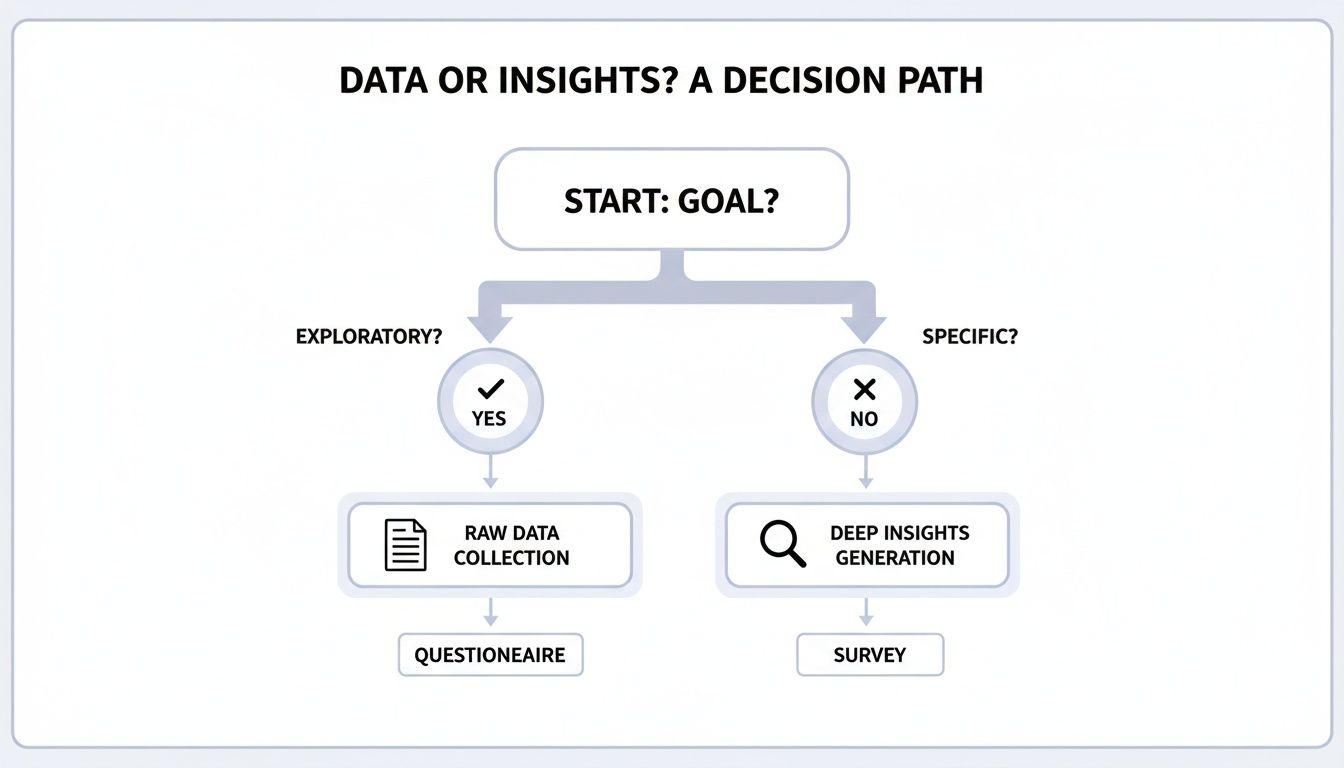
As the decision tree shows, if you just need raw information for an immediate task, a questionnaire is all you need. But if your goal is to spot deeper patterns and come away with actionable insights, you need to run a survey.
Analytical Depth and Reliability
This brings us to the biggest differentiator: analytical depth. A questionnaire gives you individual data points. A survey takes all those points, synthesizes them, and builds a coherent story, revealing trends you could never see by looking at one response at a time.
For instance, a post-purchase feedback form is a questionnaire. One customer telling you their delivery was late is a single data point. But a survey aggregates thousands of those responses and might reveal that 30% of customers in a specific region are experiencing delays. Suddenly, you’ve uncovered a systemic logistics problem that needs a strategic fix.
It's this deeper level of analysis that makes surveys so much more reliable for big decisions. The data backs this up. Globally, well-structured surveys achieve 25-35% higher response quality because of the advanced analysis they enable. A 2022 Kantar research on data collection methods found that full surveys uncover 40% more behavioral patterns than standalone questionnaires, which are great for speed but don't hold up when you need to understand the bigger picture.
This contrast in analytical power leads to a simple takeaway: choose your tool based on the complexity of the answers you need.
- For quick, transactional data: A questionnaire is perfect. Think event registrations or support tickets.
- For strategic, trend-based insights: You need a survey. This is for market research, employee engagement studies, and the like.
At the end of the day, understanding this practical difference ensures you pick the right approach for the job. It stops you from using a simple data-grab tool when what you really need is a robust research process.
When a Questionnaire Is the Right Tool
Sometimes, you don't need a sprawling research project. You just need answers, and you need them now. This is where a standalone questionnaire really shines—when your main objective is straightforward data collection for a specific task.
Think of it as a tool for getting things done. A questionnaire is perfect for situations where speed and efficiency are far more important than deep statistical analysis or spotting long-term trends. Its job is to gather the exact information needed to complete an action. You aren't trying to draw broad conclusions, so there's no need for a complex methodology; you're just moving a process forward.
Ideal Scenarios for Questionnaires
Countless daily business workflows depend on the focused power of a questionnaire. In these moments, launching a full-blown survey would just add unnecessary steps and slow things down.
Here are a few classic examples where a questionnaire is the perfect fit:
- Lead Capture Forms: That simple form you fill out after a webinar to get the slides? That’s a questionnaire. Its only job is to collect your name, email, and company so a sales team can follow up.
- Event Registration: When you sign up for a conference, the form asks for your details, which sessions you'll attend, and if you have any dietary restrictions. This data is purely for logistics, not for analyzing attendee behavior patterns.
- IT Support Tickets: An internal support form asking for an employee's name, a description of the problem, and the device they're using is a classic questionnaire. It gathers just enough detail to create and assign a support ticket.
- Simple Website Feedback: Ever seen a little pop-up asking, "Was this article helpful?" with a "Yes" or "No" button? That’s a questionnaire in its simplest form, collecting a quick data point without any fuss.
The rule of thumb is this: if the data from each submission is primarily used on its own to trigger a specific action, a questionnaire is what you need. The goal is operational efficiency, not analytical depth.
Modern form builders are built for creating these kinds of efficient tools. They come equipped with features like spam protection to keep your data clean and simple integrations that can automatically push form submissions into a CRM or a project management board.
This direct approach helps teams gather information quickly without getting bogged down in the nuances of proper survey design. If you want to get a head start, exploring a library of pre-built options can save a ton of time. You can find plenty of great examples by browsing various questionnaire and form templates that cover everything from lead generation to support intake.
Why Some Goals Demand a Full Survey
While a quick questionnaire works wonders for everyday operational tasks, big-picture business decisions require a much more disciplined approach. When you're making a strategic bet, you can't just collect raw data—you need insights you can trust. This is where a full survey process isn't just helpful; it's non-negotiable.
Simply put, a survey is essential when the cost of being wrong is too high. Before you pour serious money into a new venture or pivot your entire strategy, you need to be confident that your conclusions are built on representative, unbiased information. The deliberate methodology behind a survey, from its careful design to its statistical analysis, gives you that critical layer of validation.
Strategic Initiatives Requiring a Survey
Certain goals are just too important for a simple set of questions. They are foundational research projects that will directly shape your company's future and how you allocate resources.
Here are a few classic examples where only a true survey will do:
- Market Research Studies: Trying to find your footing in a new market or get a handle on the competitive landscape? You need to analyze trends from a sample that actually represents your target audience, not just the people who happen to answer. A survey lets you slice and dice the data to uncover the most promising customer segments.
- Product-Market Fit Assessments: Before you go all-in on a major product launch, a survey is your reality check. It helps you validate that you've actually built something people need and are willing to pay for. This goes way beyond collecting feature requests; it's about quantifying real demand and spotting potential deal-breakers before they sink your launch.
- Employee Engagement Analysis: If you're serious about reducing employee turnover and building a better culture, you have to see the forest for the trees. A survey helps you spot systemic patterns in feedback across different departments, roles, and even employee tenure, turning a collection of individual gripes into actionable organizational insights.
A survey is your best defense against making expensive assumptions. Its methodical process—sampling, structured data collection, and rigorous analysis—is designed to prevent you from misreading the signals and gives you the statistical confidence to act decisively.
The Role of Methodology and Analysis
The real magic of a survey is in its methodology. It’s not just about what you ask, but who you ask and how you interpret their collective answers. This starts with careful sampling, a process that ensures the group of people you hear from accurately mirrors the broader population you care about.
Without proper sampling, you risk building your entire strategy on the feedback of a vocal minority, which is a recipe for disaster.
Then comes the analysis. A survey is designed to uncover relationships and correlations that you’d never spot otherwise. For instance, your analysis might reveal that customer dissatisfaction is 3x higher among users who rely on one specific feature. That's a game-changing insight you would almost certainly miss by looking at isolated questionnaire responses.
This disciplined approach is what turns a mountain of ambiguous feedback into clear, evidence-based direction. It’s how you move from relying on anecdotal hunches to making decisions backed by statistical certainty. When the stakes are high, a survey isn’t just a nice-to-have—it’s an essential strategic tool.
How to Build a High-Quality Data Collection Instrument
Whether you're crafting a simple contact form or a complex market research survey, the quality of your instrument is everything. The questions you ask—and how you ask them—directly shape the quality of the data you get back. It’s not just about listing questions; it’s about thoughtful design that prioritizes clarity, user experience, and data integrity.
The bedrock of any great questionnaire is clear, neutral language. You have to be careful not to steer your audience. Leading questions, which subtly nudge respondents toward a certain answer, can poison your results with bias. For instance, asking, "How much did you enjoy our amazing new feature?" is a classic mistake. A much better, more neutral way to phrase it is, "How would you rate your experience with our new feature?" This simple switch lets people give a truly honest response.
Crafting a Dynamic User Experience
Nobody likes staring down a long, static list of questions. It's overwhelming and a surefire way to get people to abandon your form. The trick is to use dynamic features to create a more personal and engaging experience for each person.
One of the most effective tools for this is conditional logic. This feature intelligently shows or hides questions based on how someone answered a previous one. Imagine a user answers "No" to "Are you satisfied with our customer support?" Conditional logic can instantly reveal a follow-up question asking for more details. This way, you get the context you need without making every single user wade through questions that don't apply to them. If you want to master this, check out this practical guide to using a form builder with conditional logic.
Here’s a look at a builder interface where you can map out these kinds of smart rules.

The interface makes it easy to visualize how different answer paths trigger unique follow-up questions, turning what could be a complex web of logic into something you can easily build and manage.
Ensuring Data Integrity and Completion Rates
Beyond just feeling smooth, a high-quality instrument has to deliver accurate, usable data. This is where smart validation rules come into play—they're your first line of defense against messy information.
- Field Validation: Make sure an email field only accepts a valid email format or that a phone number field contains the right number of digits. This small step prevents simple typos and keeps your data clean from the get-go.
- Required Fields: Mark your most critical questions as mandatory. This prevents incomplete submissions and ensures you get the essential information you need from every single respondent.
Building a great data collection instrument is a balance of science and empathy. The science is in the logic and validation; the empathy is in creating an experience that respects the user's time and attention.
Finally, especially for the longer questionnaires used in surveys, a few user experience tweaks can make a huge difference in completion rates. Research has shown that multi-step layouts—which break a long form into smaller, digestible chunks—can boost conversions by up to 300%. When you pair that with a visible progress bar, you give users a sense of momentum and a clear finish line, encouraging them to stick with it to the very end.
Turning Your Raw Data Into Actionable Insights
Getting responses is a great first step, but it’s definitely not the end of the road. The real magic happens when you transform that raw data into meaningful action, bridging the gap between what your audience is telling you and what your business does about it. The fundamental differences between surveys and questionnaires really shine here, as each one demands a unique approach to this final, crucial step.
With a standalone questionnaire, the game is all about immediate, automated action. Think of each submission as a self-contained task just waiting to be completed. You can set up workflows that fire off in real-time, turning your form from a simple data-gatherer into an operational powerhouse that keeps things moving.

From Submission to Workflow Automation
Connecting your questionnaire to your other business tools is where the efficiency kicks in. A good form builder should play nicely with the software you already use, letting you automate tasks that would otherwise eat up valuable time.
Here are a few classic automated workflows you can build with questionnaires:
- Lead Generation: A prospect fills out your lead form. Instantly, their info zips over to your CRM, a sales rep gets assigned, and an automated follow-up email sequence begins. No leads fall through the cracks.
- Support Intake: A customer submits a support ticket. In a flash, a task is created in your project management tool, the on-call agent gets a Slack notification, and the customer receives an email with their ticket number.
- Event Registration: Someone signs up for your webinar. Their details are automatically added to a Google Sheet, and a calendar invite is sent out. Simple, seamless, and hands-off.
The whole point of questionnaire data is speed and execution. Every single response should trigger a specific, predefined action that keeps your business humming along.
From Survey Data to Strategic Decisions
When you’re dealing with a comprehensive survey, the focus shifts from instant action to deep, thoughtful analysis. You’re not trying to react to every single response. Instead, you're looking for the big picture—the collective story your data is telling. This is where you graduate from looking at data points to uncovering strategic insights that can steer major business decisions.
Your first move is to fire up your analytics tools to find trends, patterns, and segments within your data. For instance, you could filter responses by customer demographics, purchase history, or location. This might reveal that while your overall customer satisfaction is a healthy 9/10, customers in one particular region are consistently unhappy. Boom—you’ve just pinpointed a localized problem that needs a closer look.
This is the kind of analysis that helps you answer tough business questions with real evidence. Are your marketing campaigns actually connecting with the right people? Is that new product feature solving the problem you built it for? By generating reports and creating data visualizations, you can build a clear narrative that backs up your conclusions and informs your next strategic play. The insights from a well-designed survey give you the proof you need to refine a product, tweak a marketing strategy, or improve your team’s experience.
A Few Lingering Questions
Even after breaking down the differences between surveys and questionnaires, a few questions tend to pop up. Let's tackle them head-on to clear up any confusion.
Can a Questionnaire Exist Without a Survey?
Yes, and it happens all the time. A questionnaire is often a standalone tool for collecting specific pieces of information, especially when you don't need to analyze the data for broader trends. Think of it as a tool for a specific task.
You see them everywhere:
- Website contact forms
- Event registration pages
- Quick website polls
- IT support tickets
In these cases, each submission is a self-contained task. Someone fills out the form, and you act on that one piece of information. The goal isn't to find patterns across all submissions, so the whole survey process isn't necessary.
What Makes a Survey More Reliable for Big Decisions?
A survey's reliability isn't just about the questions asked; it's about the entire rigorous process built around them. This structure is specifically designed to root out bias and give you results you can actually trust.
When you're making a strategic choice, you need more than just raw data—you need evidence. A well-executed survey provides that by collecting, contextualizing, and interpreting information in a statistically sound way. That's the difference between a hunch and a solid insight.
This reliability comes from a few key steps: careful audience sampling to make sure you're talking to the right people, smart question design that avoids leading respondents, and a systematic analysis that uncovers the real story in the data.
Can I Use the Same Tool to Create Both?
Absolutely. Modern form and survey platforms are flexible enough to handle both. A great form builder can be used to whip up a simple, standalone questionnaire for daily tasks just as easily as it can be used to build the complex instrument you need for a deep-dive survey.
The tool isn't the deciding factor; your strategy is. It’s all about how you use the tool and the process you wrap around it. The platform gives you the features, but your goal determines whether you're just collecting information or conducting real research.
Ready to build smarter forms and surveys that get results? AgentsForForms uses AI to turn your goals into production-ready forms in seconds, complete with optimized questions, conditional logic, and insightful analytics. Start building for free at AgentsForForms.